
Why Skin Boosters Come as a Course: Sam Explains Sessions and Recovery, Brentwood

Skin boosters are often described in a single sentence, but the practical questions usually come next: how many sessions, how far apart, and what your skin looks like afterwards. In this article, Sam from 65Beauty explains what skin boosters do and why they are planned as a course, and we cover what to expect from consultation to aftercare.
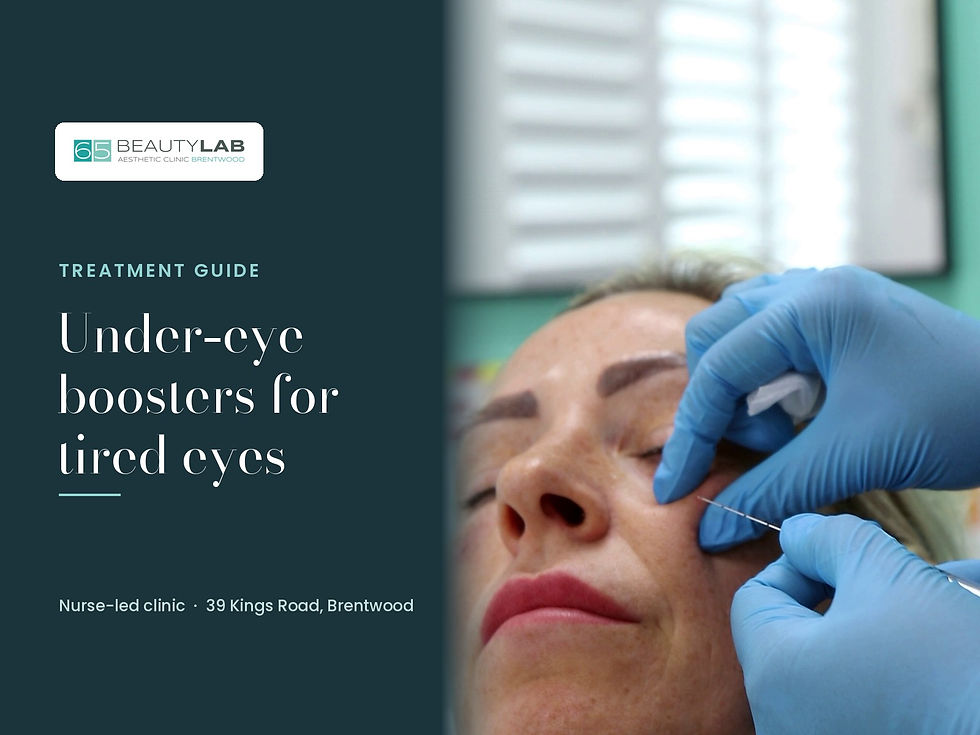
This video uses an AI-generated version of Samantha's voice and likeness, made with her consent. The treatment footage is real and filmed with consent.
Who is Sam?
Samantha, known as Sam, is a qualified osteopath at 65Beauty. Alongside her osteopathy work, she also carries out skin booster and anti-wrinkle treatments at the clinic. The practitioner shown in the treatment footage is one of Sam's 65Beauty colleagues.
65Beauty is a nurse-led, CQC-registered clinic at 39 Kings Road, Brentwood, and every aesthetic treatment we offer starts with a consultation.
What skin boosters do
As Sam puts it, skin boosters are "tiny injections that deliver hydration and nourishment deep into the skin, to help it look plumper, smoother and more radiant".
Most skin boosters are based on hyaluronic acid, a substance found naturally in the skin that helps it hold on to water. Unlike dermal filler, skin boosters are not used to add volume or change the shape of the face. They are spread in small amounts across an area to improve how hydrated and healthy the skin looks overall.
Skin boosters are not right for everyone, and results vary depending on your skin, age and lifestyle.
Why it is a course, not a one-off
Sam explains that skin boosters are usually done as a course of three or four sessions, a few weeks apart. This is one of the most common questions we hear, so here is the thinking behind it:
Building gradually. Each session adds to the last, so improvement in skin hydration and texture tends to be gradual rather than immediate.
Time for the skin to respond. Spacing sessions a few weeks apart gives the skin time to settle and respond between treatments.
A plan that fits you. The exact number of sessions and the gap between them are decided at your consultation, based on your skin and your goals.
After a course, some people choose occasional maintenance sessions. Your practitioner will talk you through what may suit you, with no pressure to commit.
What happens at your appointment
Your first step is a consultation. Your practitioner will ask about your medical history, any medication you take, your skincare routine and what you would like to achieve. They will look at your skin and check suitability before anything goes ahead. If skin boosters are not the right fit, they will explain why and talk through other options.
If you decide to go ahead, the area is cleansed and the product is placed with a series of very small injections across the treatment area. Your practitioner will explain each step as they go.
After your treatment
Sam is honest about the first day or so: you might see a few small bumps where the injections were placed, but they settle quickly. Some short-lived redness, tenderness or minor bruising can also happen.
Your practitioner will talk you through aftercare before you leave, including how to look after your skin in the following days and when to get in touch if you have any concerns.
Common questions
Are skin boosters the same as dermal filler?
No. Dermal filler is generally used to add volume or shape. Skin boosters focus on hydration and the overall quality of the skin.
How many sessions will I need?
Usually three or four, a few weeks apart, but your practitioner will recommend a plan after your consultation.
When will I see a difference?
Changes are usually gradual over the course. Results vary from person to person.
You can read more about skin boosters on our Skin Boosters page.
Book a consultation
If you would like to find out whether a course of skin boosters is right for your skin, our team at 39 Kings Road, Brentwood, will be happy to see you. Book a consultation
Results vary. Treatments are for adults aged 18 and over and are subject to a consultation.


Comments